EDIT: This project stalled due to the original Sword & Sceptre project being too incomplete. This series will be edited and re-published, featuring more thoughtful worldbuilding.
This year is going to be a big one in terms of publishing my own content that has been building up. I’ve been running “experimental” TTRPG campaigns using Low Fantasy Gaming, Blueholme (plus ACKS) and now Tales of Argosa for just over five years now. I have learned a lot, and it is past time for me to share what I’ve learned.
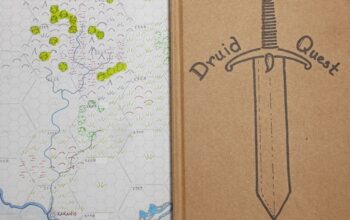
The first, and most important, aspect of this project is the Druid Quest Adventure Game, [1]which has been in development for approximately three years. The 30 Days of Worldbuilding posts will be directly aimed at filling out the World of WeirthTM as a setting. To that end there is a private wiki being developed, and a multi-player, multi-front map-based wargame campaign being run as play-by-post in the Wargame Culture Design Journal discord[2]. Session reports and information for both of these games will be published on the World of WeirthTM website.
I am working on a monthly newsletter called Domesday ’26[3], which will be published in the OG Zine tradition, printed and mailed to participants. I’m still researching the best way to make this happen. The newsletter will be available as a stack or blog post. (This part is still very much WIP!)
The World of Weirth

The multi-scale game will be happening on this map. Each hex is 25 miles, center-to-center. There are nine Barons ruling domains of seven hexes in area, who all owe fealty to the Emperor.
Each Baron player will be developing their own domain, with regard to details of culture, resources and aesthetic. The game will be run at an operational level, with four “Seasons” of activity. The longest, Campaign Season, will be run at 1:1 pacing[4] for moving troops, taking action against other players, seeking out resources, etc. The broad strokes of the campaign setting have been laid out by previous play, but the details of this map will be defined by the players and the referee.
30 Days of Worldbuilding
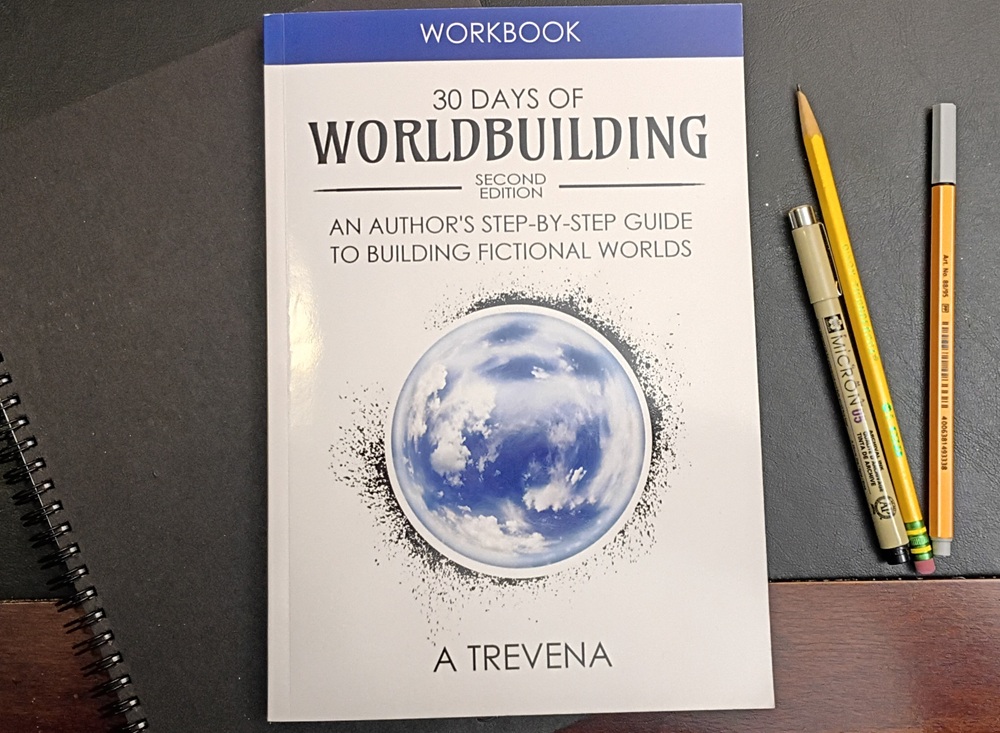
 “An Author’s Step-by-Step Guide to Building Fictional Worlds”
This workbook by Angeline Trevina is an excellent resource for generating the details of a campaign world. It is loaded with 30 prompts for defining various features, such as Genre, Natural Resources, Food, Trade Routes and Travel, Class divides, Festivals and more. I learned about it from Angeline’s substack, Step-by-Step Worldbuilding. I started working on some of the notes during our Christmas-week trip to visit my family in the Midwest. Unfortunately I did not get as much time to myself for writing as I was hoping for. Rough drafts have been written for about one third of the prompts, and I will be getting the rest down on paper over the next few days.
Thumbnail versions of responses to the prompts will be published first on the Design Journal for subscribers, the full-scale versions will be published here, under the World of WeirthTM category, over the next 90 days or so. In Q2 the posts will be collected into a zine-style gazeteer of the Empire of Zutakari.
Day 1 – Genre and Setting

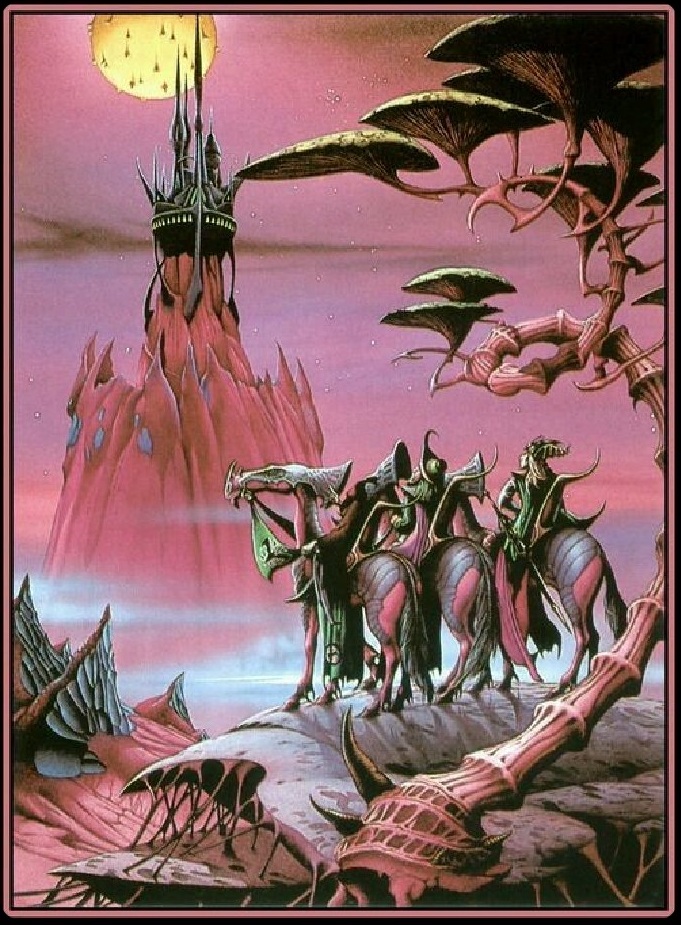
The genre of the World of WeirthTM is best described as “Pulp-informed Sword & Planet”. A familiarity with the works of Robert E Howard, Edgar Rice Burroughs, HP Lovecraft will be very useful in understanding the aesthetic of the setting I’m creating. It will also draw from comics, television and the silver screen – Monstress, The Sacrificers, Thundarr the Barbarian, Buck Rogers, and even some ideas from The Land of the Lost may make an appearance!
Using the OD&D rules, plus clarifications from Delving Deeper, we aim to create a setting featuring swashbuckling adventures on an exotic world. Medieval-style societies exist as islands of civilization surrounded by a howling wilderness. These baronies consist of agrarian settlements blending feudalism with ancient, poorly understood super-science and unpredictable sorcerous powers. The Barons ruling the various domains are Fighting Men, Clerics and Magic Users at the zenith of their powers.
Some details that inform the setting:
- Settlements are defended by walls of stone or log palisades, or sometimes built on great stone promontories. They are guarded by a garrison of armed men, and the engines of war.
- Settlements have catapults with stockpiles of ammunition in the form of large stones, barrels of pitch, and baskets of fist-sized stones to protect from aerial attack.
- The walls and gates of every settlement is planted all round with wolfbane and garlic. Undead and were-creatures are a deadly threat!
- The gates of Lawful settlements, as well as government offices & the homes of the wealthy, are equipped with basins of Holy Water. Everyone entering must dip their hand into the basin.
- Magic is dangerous and often misunderstood. Unsanctioned or unsupervised magic use may be illegal in some domains.
- It is a cultural taboo to refuse hospitality to lone travelers, food and a warm place to sleep. It is always acceptable to subject said strangers to the garlic, wolfbane and Holy Water tests.
- It is customary to leave a small offering at a roadside shrine, no matter which deity it may be dedicated to. It is equally likely that any given shrine is dedicated to one of the Elder Deities of Weirth as to one of the Petty Gods.
- Gunpowder and Radium weapons[5] are strictly regulated by the nobility, the Barons and the Emperor.
Rules-wise, we will be using a limited set of resources:
- The three original booklets of OD&D to establish the implied setting (as described here by Wayne Rossi – The Implied Setting of OD&D).
- The Delving Deeper Reference Rules Compendium for clarifications.
- The Tome of Magic, compiled and curated by yours truly, the Purple Druid, with the spells from Delving Deeper and Battle Magic as described in Chainmail.
- The Sword & Sceptre booklet, also written & compiled by Purple Druid, which has rules for generating Barons, Domains, and large-scale hex crawling at Domain Scale.
- The Leader of Men booklet, written & compiled by Purple Druid, rules for abstracted combat, movement, supplies and communications over the campaign map.
Day 2 will feature Interesting Locations and Points of Interest. Click the tag [ 30 Days of Worldbuilding ] for all of the posts in this series.
References
- Druid Quest is the working title of a rules supplement for running RPG campaigns at multiple scales simultaneously.
↩ - The Design Journal discord is available to free and paid subscribers of the Wargame Culture substack –
wargameculture.substack.com.
↩ - “Domesday ’26” is the newsletter of the Sword & Sceptre Society, a playtest group exploring a methodology for Domain- and Faction-play in a multi-scale RPG. Paid subscribers to the Wargame Culture Design Journal will be the first to get details on this newsletter.
↩ - 1:1 pacing is a traditional, “old school” method of timekeeping in a wargame where in-game time is matched to the real-world calendar. Thus, one week of time in game equals one week of IRL calendar time. If an army leaves City A on August 2 and it will take them three weeks to march to the neighboring domain, they will arrive on August 23 in-game AND after three actual weeks have passed IRL.
↩ - Gunpowder weapons are quite primitive, even by Pulp standards. “Handguns” such as the arquebus exist (see Chainmail). Radium weapons are classed as pistol-like handguns and long-barreled versions similar to muskets. The manufacture of Radium Guns and their ammunition is a secret kept by the Emperor. Unsanctioned possession of either type of firearm is punishable by death.
↩